
G∞SE
Modular Ground Support Equipment
Goose is our self-developed ground support equipment and test stand, interfacing with liquid bipropellant rocket engines. It is one of the only successful high school-built propulsion test stands.
Initially built for the Cardinal static fire campaign, it now serves to validate future propulsion projects. Goose will be used throughout the lifecycle of our engines, from injector flow testing to cold flows and ultimately static fires.
Max pressure: 1000 psi
Max mass flow rate: 1.8 kg/s
Goose is intentionally modular in its design, allowing significant operational flexibility. Each element in the test stand can be disconnected and transported separately.
For Cardinal, Goose was configured with five sub-modules: oxidizer run tank, fuel run tank, nitrogen pressurant, oxidizer fill tanks and engine mount. Future projects may add or subtract these submodules as needed, making Goose highly customizable as well. The tank stands are intentionally oversized to accept propellant tanks up to double the current volume. This ability will be important in rapidly iterating flight engines.
In its current configuration, Goose features 13 servo-actuated and solenoid valves, controlled by the Genesis PCB with automatic valve sequencing capabilities.
Genesis
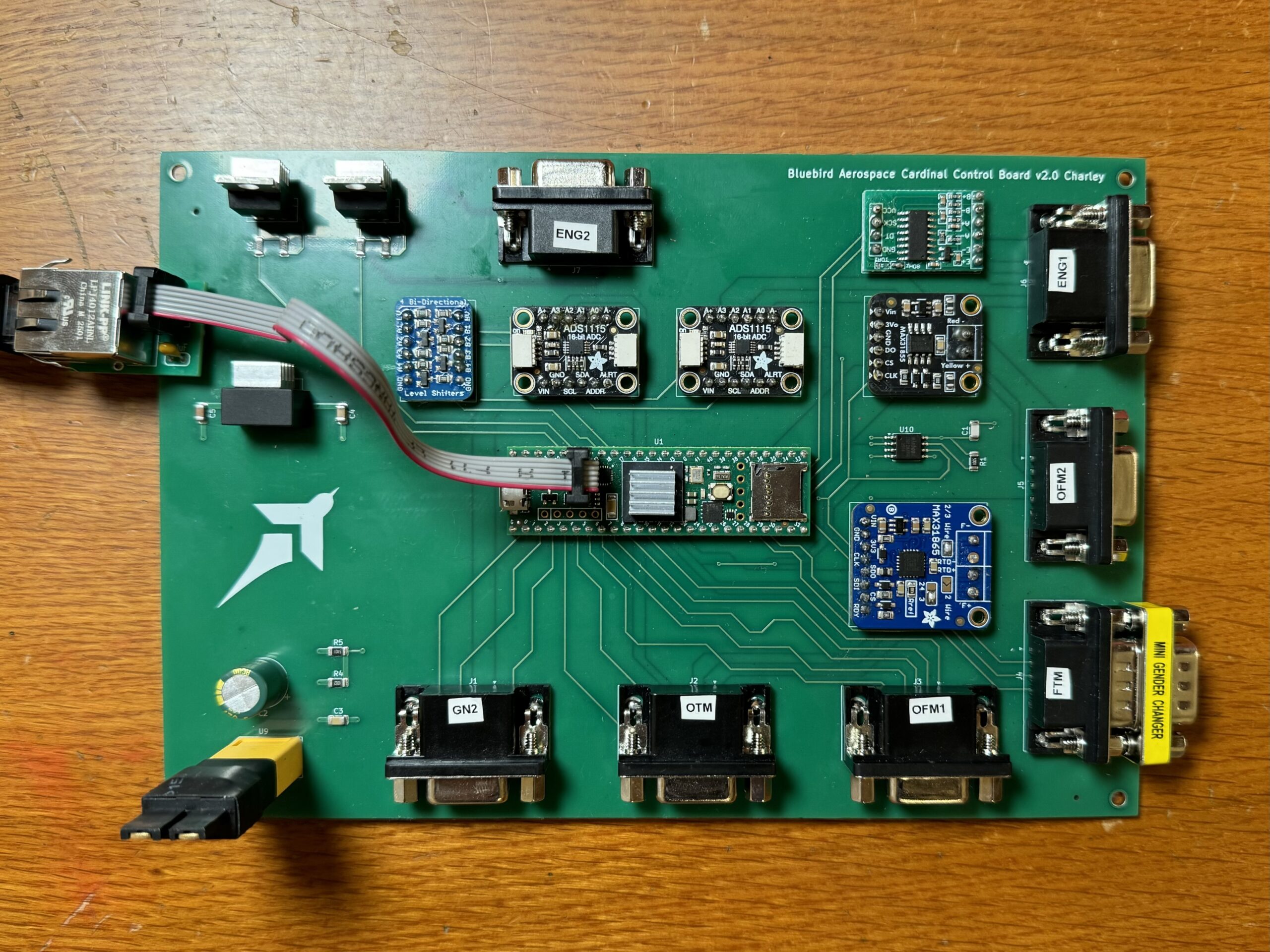
The Goose GSE system is primarily controlled by Genesis, a custom breakout-board based PCB.
Genesis is capable of controlling 13 servo actuated ball valves or solenoid valves. The board can deliver a maximum of 30A of current split across each servo. Genesis communicates with the user interface through a high-speed ethernet cnonnection.
The board also includes onboard data acquisition channels, reading up to 8 pressure transducers at 16 bit resolution, a load cell at 24 bit differential, and both K-type and RTD temperature sensors.
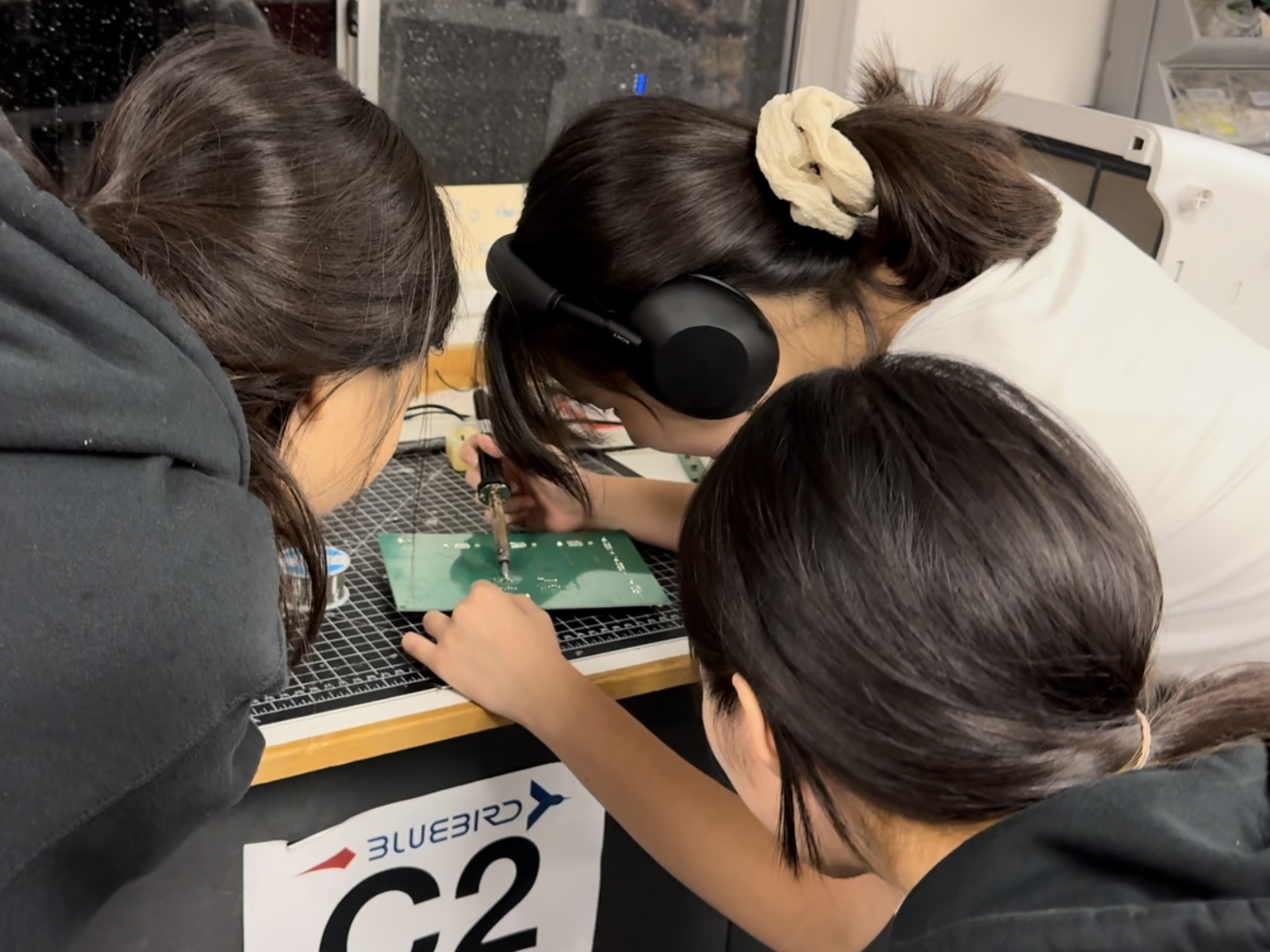
As Bluebird’s first circuit design project, Genesis was initially prototyped on a perfboard, then transferred to a printed circuit board. The process of routing and manufacturing gave us the skills needed to develop more advanced electronics.
We also learned important lessons regarding electromagnetic interference, experimenting with the placement and size of decoupling capacitors.
Synnax UI
Data acquisition for Goose is now primarily handled by a LabJack T7 Terminal.